How Hplc Is Utilized To Check Peptide Purity
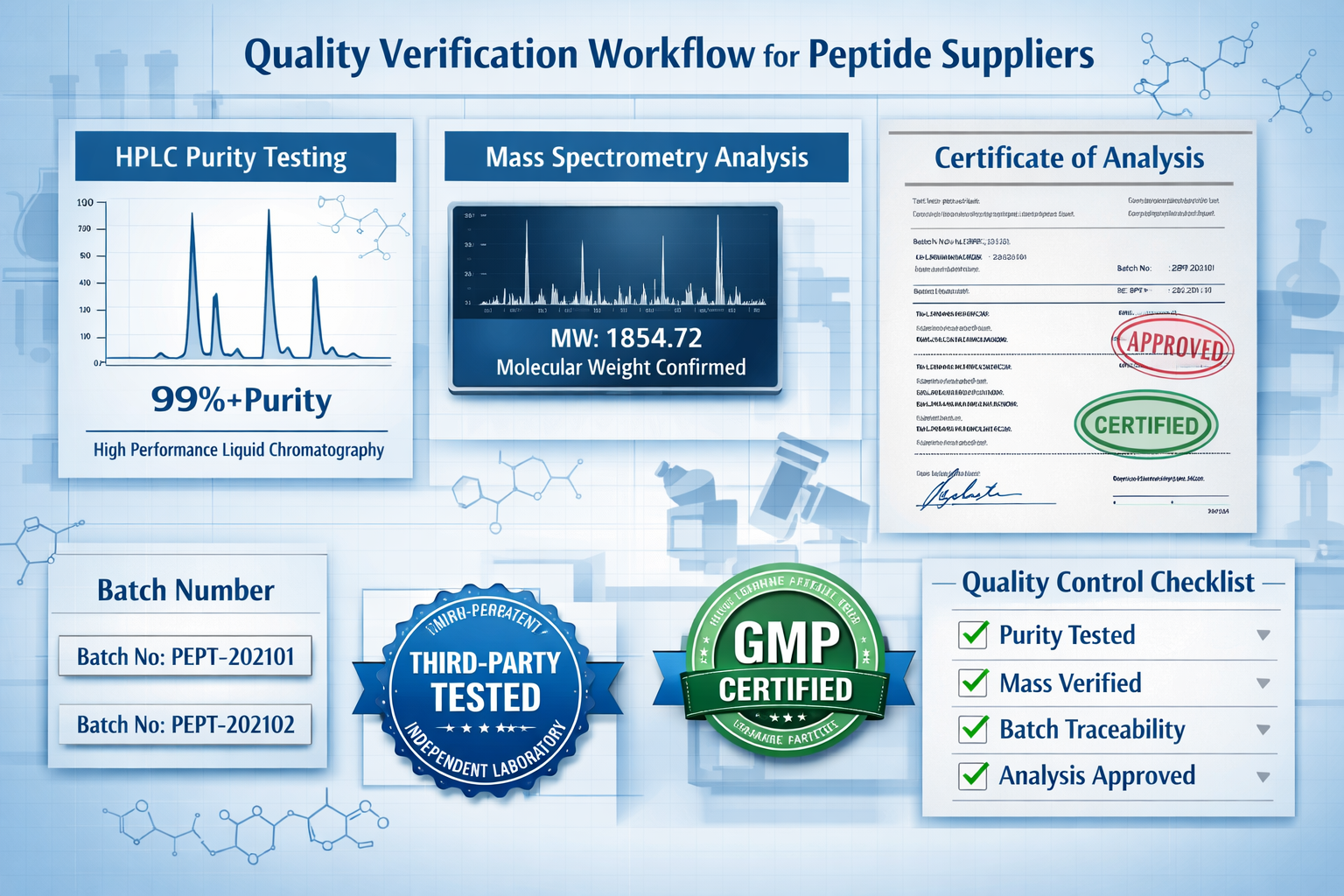
Hplc Research Laboratory, Hplc Screening Solutions Northeast Biolab In peptide study, the quality of your beginning products straight determines the integrity of your results. High-Performance Liquid Chromatography, typically called HPLC, is the gold conventional analytical method for examining peptide pureness. Understanding what HPLC screening includes and why it matters is essential expertise for any type of scientist dealing with synthetic peptides. In practical COA review, the term normally describes pureness screening, identification screening, and documents review. Purity testing asks just how much of the discovered sample is the main peptide versus related contaminations. Identification screening asks whether the gauged mass or sequence-related evidence matches the designated peptide. Documents evaluation asks whether the report is batch-specific, deducible, and outlined enough to be audited. For research study peptides, molecular weight verification validates the designated series, detects alterations such as oxidation or deamidation, and confirms the lack of impurities that could co-elute during HPLC analysis. Modern tools can perform tandem MS, breaking up the peptide to validate the actual amino acid series. Peptides are complex biological compounds, and the accuracy of your research depends on the accuracy of the material you make use of. Regrettably, the on-line market for peptides is swamped with unproven sources and irregular pureness levels. That's why Peptides Lab UK applies a two-layer confirmation system, combining independent lab screening with third-party validation via Optima Labs-- to ensure clinical stability. The target peptide looks like an unique peak, and its location relative to the overall peak location suggests the pureness portion. A well-synthesized study peptide typically accomplishes pureness levels of 98% or greater. Polluted peptides show several tops on HPLC chromatograms, molecular weight disparities in mass spectrometry, or visible fragments in option. Independent research laboratory screening discovers contamination prior to products reach scientists. Mass spectrometry offers definitive verification of peptide identification by measuring the precise molecular weight of the compound, frequently to within 0.01% of the academic value. By validating molecular structure and purity, we assist researchers keep reproducibility and abide by regulative standards. Our analytical services supply self-confidence in every peptide set, reducing speculative danger and sustaining both preclinical and clinical applications where precision is vital for success. It is thought about the gold-standard technique for assessing just how much of a sample is the desired peptide versus contaminations [2] For example, a peptide at 95% pureness still contains ~ 5% byproducts that might disrupt delicate experiments if undetected [2] By utilizing HPLC to make sure a peptide is, say, 98-- 99% pure, researchers considerably decrease the risk of such confounding variables. It helps verify that peptide-based drugs fulfill the high standards for security and effectiveness. Strong Stage Peptide Synthesis (SPPS) is based upon consecutive enhancement of alpha-amino and side chain protected amino acid deposits to an insoluble polymeric support. Briefly, synthesis is performed by stepwise addition of activated amino acids to the strong support (Wang resin and PEG-PS) beginning with the carboxy terminus to the amino terminus. At the end of the synthesis the peptides were cleaved off the material by reagent R (90% TFA, 5% Thioanisole, 3% Ethanedithiol, and 2% Anisole) and subjected to multiple ether removals. Peptides communicate with a nonpolar fixed stage, dividing based upon hydrophobicity. Monitoring at 214 nm offers broad sensitivity since the peptide foundation takes in highly at this wavelength. Independent confirmation via third-party research laboratories removes problems of passion that can endanger top quality claims. When the same company both makes peptides and evaluates them, rewards exist to existing favourable results even when material top quality fails. Examinations must include utilizing confirmed analytical techniques to evaluate identification, purity, potency, and security Helpful site at every phase of the item's advancement and usage. We frequently utilize slope elution in peptide purity analysis, that is, the percentage of organic stage (mostly acetonitrile) in the eluent gradually enhances with time. Since the price of enhancement of natural phase has a significant impact on the purity outcome. We normally make use of a slope elution approach every min (the concentration of acetonitrile increases by 1% every minute, v/v), which can stay clear of the overlap of sample optimals and pollutant peaks and boost the accuracy of evaluation outcomes. This write-up is attended to academic and study reference objectives just. If a peptide is re-tested after storage space stress, HPLC can reveal whether brand-new pollutant tops have appeared or whether the major height location has decreased. This attaches straight with taking care of topics such as peptide storage space and peptide reconstitution. Impurities in peptide examples can originate from incomplete synthesis, side reactions, or destruction throughout handling and storage. These contaminations-- which may consist of abbreviated sequences, deletion peptides, or oxidation products-- can disrupt experimental lead to unforeseeable methods. A peptide example provided at 95% pureness includes 5% unidentified substances that can activate false favorable results, mask true organic results, or present undesirable variables right into very carefully designed experiments. High-performance fluid chromatography (HPLC) testing is an analytical chemistry procedure to divide, spot, and evaluate drugs and their metabolites within different formulas, cars, and biological matrices.
Hplc Vs Various Other Peptide Characterization Methods
- To validate your COA visit any one of our item web pages-- scroll down and replicate the batch number, after that see optimalabs.org to verify.
- This approach makes certain that scientists can have total self-confidence in the pureness and identity of the peptides they get [4]
- Documents review asks whether the record is batch-specific, deducible, and detailed sufficient to be examined.
Provide Your Bioanalysis Study Details
SelankHow much does peptide HPLC testing expense?
The expense of peptide analysis solution differs dramatically based upon which methods your regulative bundle requires: HPLC-UV Evaluation: $& #x 24; 300 & #x 2013; & #x 24; 800 per sample (standard purity assessment) LC-MS (Liquid Chromatography-Mass Spectrometry): $& #x 24; 600 & #x 2013; & #x 24; 1,500 per example (molecular weight verification).